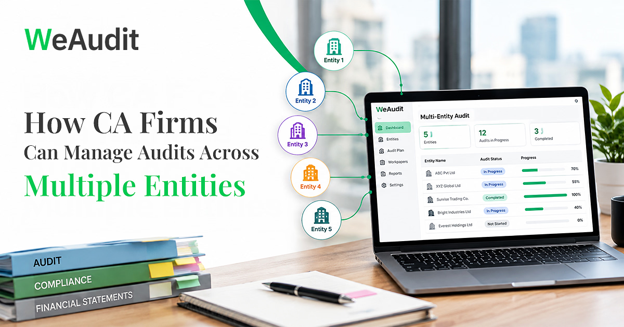
Managing audits across multiple entities is more than repeating the same audit process several times. Each entity may have different books, transactions, risks, compliance requirements, and audit teams, while the overall engagement still requires consistency in planning, documentation, review, and reporting.
For CA firms handling group companies, subsidiaries, branches, or related entities, the challenge is to create one consistent audit framework without losing sight of the risks unique to each entity.
Why Managing Multiple-Entity Audits Is Challenging
A multiple-entity audit becomes difficult when information, responsibilities, and evidence are spread across teams and files. Different books and data formats, multiple audit teams, entity-specific reporting requirements, and inter-company balances all add complexity. Partners and managers also need visibility into the status of each entity, while teams must maintain consistent working papers, evidence, and review notes. As the number of entities grows, these challenges can lead to duplicated work, delayed reviews, inconsistent documentation, and reduced engagement visibility.
A Practical Framework for Managing Multi-Entity Audits
Define the Scope and Responsibilities for Each Entity
Clearly define the scope, reporting requirements, timelines, assigned audit team, and reviewer for each entity. Clear ownership prevents gaps and establishes accountability.
Standardize Audit Procedures Across Entities
Create a common audit program for recurring procedures such as ledger scrutiny, reconciliations, financial statement verification, and compliance checks. This provides a consistent baseline while allowing additional procedures for entity-specific risks.
Centralize Financial Data and Working Papers
Keep financial information, audit evidence, working papers, and supporting schedules organized within a structured workflow. This reduces repeated file collection and dependence on disconnected spreadsheets and folders.
Establish Entity-Wise Review and Approval Workflows
Each entity should follow a defined review path so procedures, observations, and approvals remain visible until closure. This gives managers better control over the engagement.
Track Inter-Company Transactions and Reconciliations
Inter-company balances should be identified, matched, investigated, and documented across the relevant entities. Differences should be investigated and resolved at the entity level rather than being masked by the consolidated view.
Monitor Audit Progress and Outstanding Items
Partners and managers should be able to see which entities are complete, which procedures remain pending, and which review points need attention. This makes follow-ups easier and helps keep the engagement on schedule.
Key Areas to Standardize Across Multiple Entities
CA firms should standardize recurring areas such as audit planning, materiality and risk assessment, ledger scrutiny, financial statement verification, statutory compliance checks, and reconciliations. Common approaches make procedures consistent and easier to review.
The same applies to working papers, review notes, and final reporting. Standardized formats and review procedures make documentation easier to compare, help track observations to closure, and ensure final conclusions are properly supported.
| Audit area | What to standardize |
|---|---|
| Audit planning | Scope, timelines, responsibilities |
| Materiality & risk | Assessment approach and documentation |
| Ledger scrutiny | Checks and exception criteria |
| Reconciliations | Format, ownership, follow-up |
| Working papers | Templates and documentation |
| Review notes | Assignment and closure |
| Final reporting | Review and approval |
The objective is not to make every entity identical, but to ensure differences are driven by actual risks rather than inconsistent processes.
How Technology Helps CA Firms Manage Multi-Entity Audits
Technology becomes valuable when multiple entities, teams, and transaction volumes make manual coordination difficult. Centralized audit management can give partners and managers a consolidated view while retaining entity-level visibility. Entity-wise data organization keeps financial information, audit work, and supporting documents structured correctly.
Technology can also support automated ledger scrutiny, applying defined checks across large transaction populations and surfacing exceptions for review. Reconciliation and exception identification can help teams focus on differences requiring investigation rather than manually checking every record.
A common digital workflow can support standardized working papers, team collaboration, review tracking, and an audit trail. Together, these capabilities give firms clearer visibility over entity-level work, reviews, exceptions, and engagement status without relying heavily on manual coordination.
How to Maintain Consistency Across Entity-Level Audits
Consistency starts with a common audit framework. Standardized checklists define the procedures expected for each entity, while common working-paper formats ensure that evidence, findings, and conclusions are documented consistently. Consistent review procedures establish how work is checked and how review notes are raised, assigned, and resolved. Common documentation standards further create a reliable audit trail.
However, consistency should not mean treating every entity identically. Different transaction patterns, risk profiles, compliance requirements, or unusual areas may require additional scrutiny. The principle is simple: standardize the process, but customize the response to risk. This maintains consistency without limiting professional judgment.
Common Mistakes to Avoid When Managing Multiple-Entity Audits
Problems arise when procedures vary between entities, inter-company balances are poorly reconciled, or teams maintain multiple versions of working papers. Delayed reviews, unresolved observations, and excessive reliance on manual data consolidation can further create errors and rework. As the number of entities grows, these gaps can quickly lead to duplicated work, delayed reviews, and reduced visibility over the engagement.
When Should a CA Firm Consider Audit Management Software?
A CA firm should consider audit management software for CA firms when increasing entities, transaction volumes, or audit teams make engagement-level visibility difficult. Frequent partner reviews, growing documentation requirements, difficulty tracking status, and repetitive manual procedures are also indicators that the existing process may no longer scale efficiently.
FAQs
1. How do CA firms manage audits for multiple entities?
By defining entity-level responsibilities, standardizing recurring procedures, centralizing documentation, establishing review workflows, and monitoring each entity's progress and outstanding items.
2. What are the biggest challenges in multi-entity audits?
Coordinating teams, managing different financial data, maintaining consistent documentation, reconciling inter-company balances, and tracking entity-level findings are key challenges.
3. How can CA firms standardize audits across multiple entities?
They can use common audit programs, checklists, working-paper formats, documentation standards, review procedures, and reporting workflows while adapting procedures to entity-specific risks.
4. Can audit software manage multiple entities?
Yes. Multi-entity audit software can organize entity-level information, standardize workflows, automate repetitive analysis, and improve visibility into audit progress.
5. How can auditors track multiple audit engagements?
By assigning responsibilities, setting deadlines, tracking completed and pending procedures, maintaining review notes, and monitoring unresolved items through a centralized workflow.
Conclusion
Effective multi-entity audit management requires standardized procedures, entity-level risk assessment, centralized documentation, and clear review workflows. Together, these create a consistent framework for managing multiple entities without treating their risks as identical.
Technology can reduce repetitive data handling, administrative coordination, and manual tracking, giving audit teams better visibility across engagements. The goal is not simply to manage more entities, but to manage them with greater consistency, control, and confidence while keeping auditors focused on the exceptions and professional judgments that matter most.
Disclaimer: The information contained in this article is provided for general informational purposes only and does not constitute professional, financial, statutory or legal advice. Readers should not act or refrain from acting on the basis of any content included herein without seeking appropriate professional advice on the specific topics discussed.